Canton Is Not a Blockchain - Here’s Why That Matters for RWAs
There’s a question that keeps coming up in institutional finance: How do we capture the benefits of tokenization while giving tokenized assets real access to DeFi and the broader Ethereum ecosystem? It almost always leads to the next one: Which platform should we actually build on — and why?
This three-part series explores real-world asset (RWA) tokenization head-on. We start with Canton, a distributed ledger purpose-built for institutional asset issuance, and compare its architecture directly to Ethereum. (If you’re new to the series, here’s Article 2: How Tokenized RWAs Connect to DeFi and Article 3: The Risks of Investing in Tokenized RWAs.)
The Core Difference
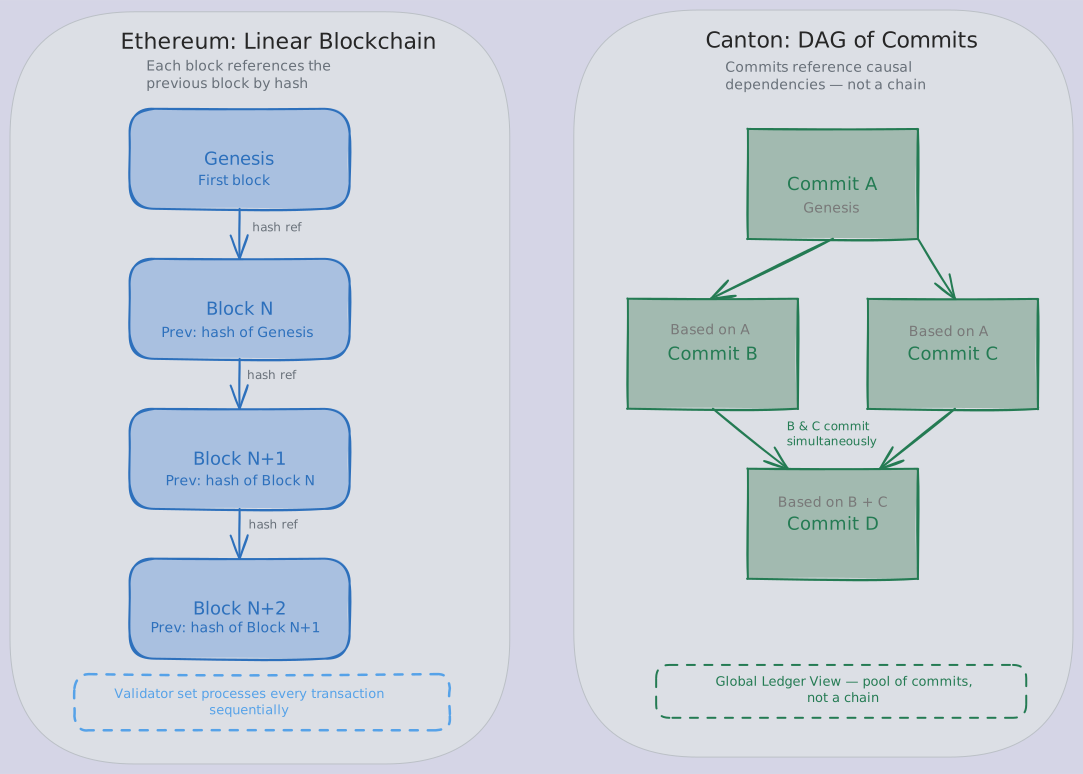
When people say “blockchain,” they usually picture one very specific thing: blocks of transactions chained together, each carrying a cryptographic hash of the previous block. That linear chain is what creates the famous tamper-evident history. Every participant runs a full copy of the ledger. Change anything in an old block and the entire chain after it breaks. The network spots the mismatch and rejects the altered copy. No single party can quietly rewrite the past.
Ethereum is exactly that kind of blockchain. Transactions get bundled into blocks. Each block points back to the one before it. Validators around the world process every transaction and agree on one global, linear order.
Canton is not a blockchain — even though you’ll sometimes see it marketed that way. It’s a distributed ledger technology (DLT) database built as a DAG (Directed Acyclic Graph) of commits. Each commit is an atomic transaction that either succeeds completely or fails entirely. Commits reference each other only by causal dependency, not by strict linear sequence. Two unrelated groups can commit transactions at the exact same time without either being “before” the other.
What a DLT Database Actually Is
Start with a simple bank ledger: Alice pays Bob $100, the bank debits one account and credits another. One authority, one source of truth. The challenge appears when multiple institutions need to share data without trusting a central operator.
A custodian, prime broker, and fund administrator all need to agree on positions, but they don’t want every detail broadcast to the entire market. That’s the problem DLT was designed to solve.
In Canton, each participant runs a node and holds only the parts of the ledger they’re entitled to see. The system is built around the Virtual Global Ledger (VGL) — think of it as a shared spreadsheet where each tab is visible only to the parties who need it. No single node ever holds the complete picture.
The ledger itself is a DAG of commits. There is no global clock forcing every transaction into one universal order. Only causal relationships matter. This design lets independent workflows run in parallel with deterministic finality and built-in privacy.
Ethereum’s Architecture
Ethereum works the opposite way. Transactions are broadcast network-wide. Validators package them into blocks, each block hashing the previous one. Once two-thirds of validators attest, the block is finalized. The result is one giant, fully replicated ledger visible to roughly 10,000 validators worldwide. Everyone sees everything. That transparency is powerful — it’s what makes Ethereum auditable, decentralized, and composable. For many regulated institutions, it’s also a non-starter. A corporate treasurer simply cannot have payment flows or large positions visible to competitors.
Side-by-Side
| Aspect | Ethereum | Canton |
|---|---|---|
| Ledger structure | Linear blockchain | DAG of commits (causal ordering) |
| Who validates | Every validator validates everything | Only the involved parties validate |
| Data visibility | Full public ledger | Need-to-know only |
| Consensus | Proof of Stake (global) | Proof-of-Stakeholder (transaction-specific) |
| Finality | ~12 min economic finality | Deterministic (no reorgs possible) |
| Smart contracts | Solidity / EVM | Daml (functional language) |
| Throughput | 15–30 TPS (base chain) | Thousands of TPS per sync domain |
| Users | Open, permissionless | Consortium of known institutions |
Why This Matters for Real-World Assets
Institutional assets come with requirements that pure public blockchains struggle to meet.
Confidentiality is non-negotiable. A fund manager holding a large tokenized bond position cannot have that exposure visible to the entire network. On Ethereum, addresses and amounts are public. On Canton, position data stays private to the entitled parties.
Regulatory oversight without public exposure. Regulators need audit rights without seeing every transaction in real time. Canton supports observer roles that grant read access to specific contracts — no need to become a full network participant.
Complex, multi-party settlement. A delivery-versus-payment deal might involve a custodian, settlement agent, prime broker, and two funds. On Ethereum this becomes one visible transaction. On Canton each party sees only their leg, yet the entire workflow settles atomically. Any failure rolls everything back cleanly.
Institutional-grade scale. Ethereum’s shared blockspace leads to fee spikes during congestion. Canton’s architecture lets different application domains run independently while still coordinating cross-domain activity through shared sync domains.
The Volume Speaks for Itself
Canton is already operating at serious scale. Broadridge’s Distributed Ledger Repo platform on Canton processes roughly $350–380 billion in average daily U.S. Treasury repo financing, with recent monthly volumes topping $8 trillion. Overall, the Canton Network supports over $6 trillion in tokenized real-world asset activity.
By comparison, public Ethereum currently hosts roughly $12–16 billion in non-Canton RWA tokenization. The gap isn’t accidental — it reflects which architecture better fits institutional constraints.
The Question to Ask
Calling this a “Canton vs. Ethereum” debate is a category error. These are two different systems optimized for different worlds.
Ethereum is the public, transparent, globally replicated blockchain built for decentralization, open access, and programmable money. It powers DeFi, NFTs, and permissionless innovation.
Canton is a privacy-first DLT database built for institutional finance, regulated workflows, and complex multi-party coordination. It shines when confidentiality, compliance, and atomic settlement across known counterparties are the priority.
The real question isn’t “Why isn’t Canton on Ethereum?” It’s “Which system is architecturally suited to the problem you’re actually trying to solve?”
References
- Canton documentation: “The ledger model in Daml” — docs.digitalasset.com
- Canton documentation: “Canton pruning” — docs.digitalasset.com
- Canton Network statistics and ecosystem data (including Broadridge DLR volumes) — canton.network
- Flashbots forum: “Deep Dive on Permissioned Blockchains — The Canton Network” — collective.flashbots.net
- Broadridge Distributed Ledger Repo (DLR) official page and press releases — broadridge.com
- Halborn: “Daml and Canton: An Introduction” (covers DLT vs. blockchain distinctions for institutional use) — halborn.com
Continue the series: Article 2: How Tokenized RWAs Connect to DeFi →
Have a project in mind?
If you're exploring blockchain infrastructure, DeFi protocol design, or emerging tech strategy, let's discuss how I can help.