How Tokenized RWAs on Canton Connect to Ethereum DeFi
In the first article in this series, I explained why Canton and Ethereum aren’t really competing. Canton is a privacy first DLT database built for institutions. Ethereum is a public blockchain built for open, composable finance. They are different tools for different jobs, and they work best together.
This is the second article in a three-part series. Article 1: Canton Is Not a Blockchain - Here’s Why That Matters for RWAs · Article 3: The Risks of Investing in Tokenized RWAs
So the natural follow-up question is this: how does capital actually move between them?
There are two practical paths for Canton-based RWAs to tap into DeFi opportunities.
Path One: Native DeFi on Canton
Canton supports smart contracts written in Daml. You can therefore run lending, collateral management, and basic liquidity protocols directly on the network. A tokenized Treasury or money-market fund share can serve as collateral in a Canton-native lending pool. The whole process stays inside the institutional perimeter.
The advantage is clear. Full privacy, regulatory compliance, and atomic settlement remain intact the entire time. No bridges and no public exposure are required.
This path works well for closed-loop institutional workflows. The limitation is liquidity. Canton’s native DeFi ecosystem is growing fast, but it still does not match the depth and variety available on Ethereum.
Path Two: Bridge to Ethereum via Stablecoins (The Institutional Standard)
This is the model that is gaining real traction in the market.
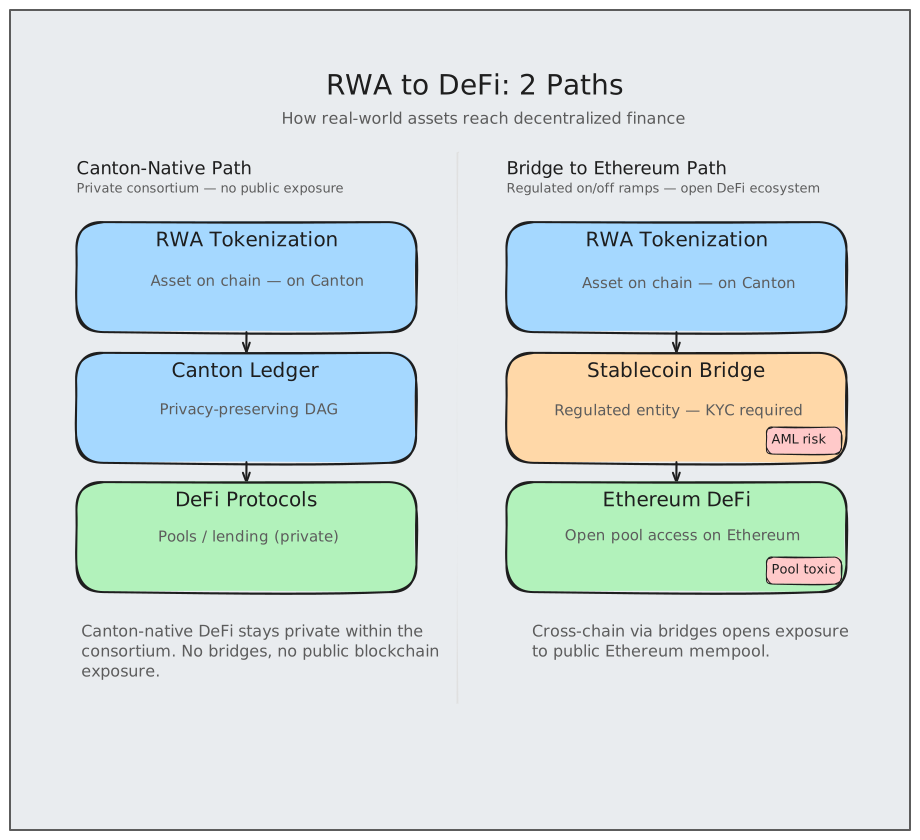
Here is how the flow actually works in practice:
-
Tokenize the asset on Canton. A U.S. Treasury, money-market fund share, or other real-world asset is issued as a digital token inside Canton’s privacy-protected environment. Positions stay confidential. Regulators or auditors get observer access as needed.
-
Post it as collateral on Canton. The tokenized asset backs a margin or lending position in a Canton-based protocol. Everything stays within the institutional perimeter.
-
Mint a stablecoin against the collateral. The margin position generates a stablecoin (USDC, a regulated institutional stablecoin, or a purpose-built Canton-native version). The minting happens entirely on Canton.
-
Bridge only the stablecoin to Ethereum. A secure cross-chain bridge moves the stablecoin from Canton to Ethereum. The original RWA never touches the public chain.
-
Deploy into Ethereum DeFi. Once on Ethereum, the stablecoin can access the full spectrum of DeFi: lending markets (Aave, Compound), liquidity pools (Curve, Balancer), perpetuals, yield vaults, and structured products.
The regulatory wrapper and position data remain on Canton. The liquidity and yield generation happen on Ethereum. It is a clean separation of concerns.
Why This Model Matters
Ethereum DeFi currently holds roughly $60B+ in lending protocols alone. That depth of liquidity simply is not available inside any single permissioned network. At the same time, most institutions will not post tokenized RWAs directly onto Ethereum. Every transaction and position would become visible to the entire network.
The stablecoin-bridge approach solves the problem elegantly. Canton handles the regulated, private side. Ethereum supplies the open liquidity. Each system plays to its architectural strengths.
This is not theoretical. Broadridge’s Distributed Ledger Repo platform on Canton already settles roughly $350–365 billion in average daily U.S. Treasury repo financing, with recent monthly volumes topping $8 trillion. The infrastructure for large-scale, privacy-preserving issuance and collateralization is proven and live.
The Centralization Critique and the Reality Check
Critics often point out that Canton is a consortium network of known participants. It is less decentralized than Ethereum’s thousands of independent validators. That is a fair observation. Trust assumptions are different.
But the line is blurring fast in both directions. On Ethereum, major stablecoin issuers like Circle (USDC) and RWA platforms like Ondo have layered on KYC, AML, and compliance rails for institutional capital. Privacy-focused Layer 2s (zkSync, Starknet, Polygon zkEVM) now let institutions obscure transaction details while still benefiting from Ethereum’s security.
In practice, the two networks are converging toward a hybrid reality. Canton gives institutions the privacy and controls they need. Ethereum delivers the open, programmable liquidity layer. They are not rivals. They are becoming complementary rails in the same financial stack.
The Real Question for Institutions
The debate is not “Canton or Ethereum?” It is “Which part of the workflow belongs where?”
Use Canton for regulated issuance, confidential positions, and complex multi-party settlement. Use Ethereum for transparent, composable, high-liquidity DeFi strategies.
The winning institutional play, already visible in the market, is to use both.
Continue the series: Article 3: The Risks of Investing in Tokenized RWAs →
References
- Canton Network documentation and ecosystem overview — canton.network
- Broadridge Distributed Ledger Repo (DLR) platform and volume reports — broadridge.com
- Canton Network: Broadridge DLR ecosystem page — canton.network/ecosystem/broadridge-dlr
- Circle institutional stablecoin infrastructure and cross-chain transfers — circle.com
- Ondo Finance: Regulated RWA access to DeFi — ondo.finance
- Flashbots forum discussion on Canton-Ethereum integration — collective.flashbots.net
Have a project in mind?
If you're exploring blockchain infrastructure, DeFi protocol design, or emerging tech strategy, let's discuss how I can help.