Open USD, Canadian stablecoins and the problem of yield
Not legal advice: this post discusses regulatory and market structure issues at a high level. Any issuer, fund manager, market maker, dealer, protocol team, or stablecoin issuer would need specific legal advice before relying on any structure described below. My perspective is shaped by my prior career as a tradfi banker and by roughly eight years working with blockchain and DeFi.
TLDR
Open USD is interesting because it is not just another USD stablecoin announcement. It appears to be an attempt to create a shared stablecoin network where large financial, payment, technology, crypto, and infrastructure firms can participate in the economics of the stablecoin.
That raises an obvious Canadian question: could a similar consortium style Canadian dollar stablecoin emerge in Canada?
My view is that Canada could follow the consortium idea, but probably not the same economic model. The Canadian framework appears to push stablecoins toward low-risk payment and settlement instruments, not yield products. That may produce safer CAD stablecoins, but it also creates a harder business problem: how do Canadian stablecoin issuers grow supply and liquidity when they cannot pay yield directly or indirectly to holders?
The likely Canadian path is a three-layer model:
- CAD stablecoins as payment and settlement rails
- DEX, RFQ, OTC, and market-maker liquidity as the conversion rail
- Tokenized RWA, money market, and short-term fixed income products as the yield layer
In that model, yield is not paid on the stablecoin. Yield is earned through a separate regulated investment product. Liquidity still matters because payment recipients, users, and institutions need confidence that they can convert CAD Stables into other assets when needed. The open question is whether CAD stablecoin issuers can fund enough liquidity, partnerships, and ecosystem development to make CAD stables useful before the market defaults to USD stablecoins and USD DeFi yield.
Open USD announcement
On June 30, 2026 we saw an interesting announcement: more than 140 of the world’s largest companies are backing a consortium to issue a new USD stablecoin, Open USD, or OUSD.
Circle’s share price dropped following the announcement, likely reacting to the perceived competition. I say “perceived” because there is still limited information on OUSD. At this stage, the announcement mainly describes headline characteristics of a stablecoin that has not yet been issued.
The key characteristics appear to be:
-
No mint or burn fees
Businesses can mint and redeem without cost and without artificial volume limits, other than the requirement that the token be properly backed by reserves. -
Reserve economics
Partners issuing or distributing Open USD will receive the majority of the earnings on the reserves, minus a small management fee to cover operating costs. -
Consortium-style governance
Open USD will be operated by Open Standard, an independent company with a board made up of partners.
What makes this interesting is not simply that Open USD is another USD stablecoin. It is designed around shared economics. The reserve income is not meant to be captured only by a single issuer.
What we still do not know about Open USD
There is still limited critical information on several important points.
| Question | Why it matters |
|---|---|
| Who is the legal issuer? | Determines redemption rights, licensing, and regulatory obligations. |
| What assets back the reserves? | Cash, T-bills, repos, tokenized funds, and other assets carry different risks. |
| Who are the reserve managers and custodians? | Important for credit, liquidity, operational, and insolvency risk. |
| What chains will it launch on? | Some reports mention Base, Solana, and others, but details are not fully disclosed. |
| Can non-partners redeem directly? | Important for liquidity, holder protection, and run-risk. |
| Is yield shared only with partners, or also end users? | Central to the legal and regulatory analysis. |
| What happens during a run? | Redemption priority, liquidity buffers, and settlement cutoffs matter. |
| How does governance work in practice? | A partner board sounds neutral, but voting rights and conflicts matter. |
Given the lack of detail, it is difficult to reach strong conclusions. Open USD is clearly a potential threat to the current issuer-led reserve income model, including Circle’s USDC, but the full picture is still emerging.
Open USD as an option play on U.S. regulation
Some commentators have argued that Open USD is an “option play” on whether the CLARITY Act passes (as of July 1, 2026 it is still a proposed draft with the senate expected to vote on this in the next few months). If CLARITY does not pass, the key U.S. legislation governing payment stablecoins would be the already passed GENIUS Act.
Under the GENIUS Act alone, the restriction is mainly issuer-focused. Stablecoin issuers cannot pay interest or yield directly to holders. That still appears to leave room for third-party rewards, exchange incentives, and B2B partner economics.
The CLARITY Act would narrow that space. Its provisions are designed to prevent not only direct issuer-paid interest, but also indirect arrangements that function like deposit-like yield on stablecoin balances.
Put simply:
GENIUS asks whether the issuer is paying interest.
CLARITY asks whether the overall arrangement functions like interest on a stablecoin balance.
That distinction matters for Open USD. If the reserve economics are shared only with business partners as B2B incentives, it may fit. But if passed through to users based on holding balances, the structure becomes more sensitive under CLARITY.
Why this matters for Canada
The Open USD announcement naturally raises the question of whether we could see a similar stablecoin initiative in Canada.
Canada has a clear need for better Canadian dollar digital settlement infrastructure. CAD stablecoins could support domestic on-chain settlement, tokenized real-world assets, Canadian dollar DeFi markets, merchant payments, treasury management, and programmable financial products.
In theory, a Canadian version of Open USD could involve stablecoin issuers, banks, payment companies, crypto platforms, custodians, fund managers, RWA tokenization protocols, and market makers working around a shared Canadian dollar settlement token.
But Canada starts from a very different regulatory position.
The Canadian stablecoin framework passed as part of the March 2026 budget legislation prohibits the payment of yield directly or indirectly to stablecoin holders. That makes it much harder to copy the Open USD incentive model.
In Canada, stablecoins are being pushed toward the role of low-risk payment instruments. That may be good for safety and confidence, but it creates a harder adoption problem.
Canadian stablecoins and the problem of supply
The core problem is that yield has been one of the major tools used to build stablecoin supply.
USDC is a useful example. USDC was first issued in 2018 and now has roughly USD 73 billion to USD 75 billion in circulation (as of late June 2026). PYUSD, which launched much later, is now roughly around USD 3 billion in circulation.
By contrast, the current Canadian dollar stablecoin market remains extremely small. Based on my daily Canadian stablecoin dashboard, the aggregate circulating supply across the three CAD stablecoins I track is approximately CAD 3.4 million.
That size difference matters. USD stablecoins have had years to build liquidity, exchange support, wallet integrations, institutional acceptance, user habits, and DeFi integrations. They have also benefited from reward and yield programs that made idle balances feel productive.
I track the Canadian market daily at https://w2d.co/defi, including supply, holders, chain activity, and observable liquidity conditions.
The Canadian market is very different. CAD stablecoin supply is still small and the ecosystem is still early. QCAD is the clearest example of a securities regulated Canadian dollar stablecoin. Other Canadian dollar stablecoin activity has existed through a mix of FINTRAC/MSB registration, provincial securities treatment, exchange listing conditions, and bespoke regulatory approaches.
Under the Canadian framework, CAD stablecoin issuers likely have three main levers:
- Payment and settlement partnerships
- Liquidity partnerships
- Ecosystem development (tokenized Canadian dollar investment products and RWA vaults)
The third point may be the most important in the long run. If there is nowhere productive for CAD stablecoins to go, then CAD stables risk becoming temporary bridge assets into USD stablecoins.
The current problem: no deep CAD on-chain investment market
At the moment, there is no deep market of Canadian dollar on-chain investment products. There are CAD stablecoins, and some CAD/USD settlement and liquidity experiments, but there is not yet a widely adopted Canadian dollar tokenized money market fund, short-term bond product, or RWA vault market comparable to the U.S. dollar tokenized fund market.
This matters because, for users, idle balances have an opportunity cost.
A user holding CAD stablecoins has to compare the friction of off-ramping back to fiat CAD, the convenience of keeping CAD balances on-chain, the ability to swap into USD stablecoins, the opportunity to earn yield in USD products, and the lack of Canadian dollar on-chain yield alternatives.
In the current market, if a user wants on-chain yield, the practical route may be to swap CAD Stable into USD Stable and deploy into USD products or DeFi vaults.
That creates a problem for CAD stablecoin issuers. If the only real yield destination is USD, then the CAD Stable risks becoming a bridge out of itself.
Liquidity pools as necessary infrastructure
Creating partnerships with local and international payment providers to accept and settle Canadian dollar stablecoins is self-evident. But payments are not enough if the recipient cannot convert the CAD Stable into their preferred asset.
To that end, issuers or distributors of CAD stablecoins will likely need to ensure that on-chain DEXs have AMM liquidity pools to convert CAD Stables into other stablecoins. We have already seen CADC and CADD actively being used to fund such liquidity pools, especially on Aerodrome on Base. This is also visible in the liquidity and chain activity I track on my daily dashboard at https://w2d.co/defi.
However, these liquidity pools need to be sustainable. During the early growth phase, they will likely require subsidy from CAD Stable issuers because there is an opportunity cost to tying up capital in a DEX liquidity pool.
The simplified structure looks like this:
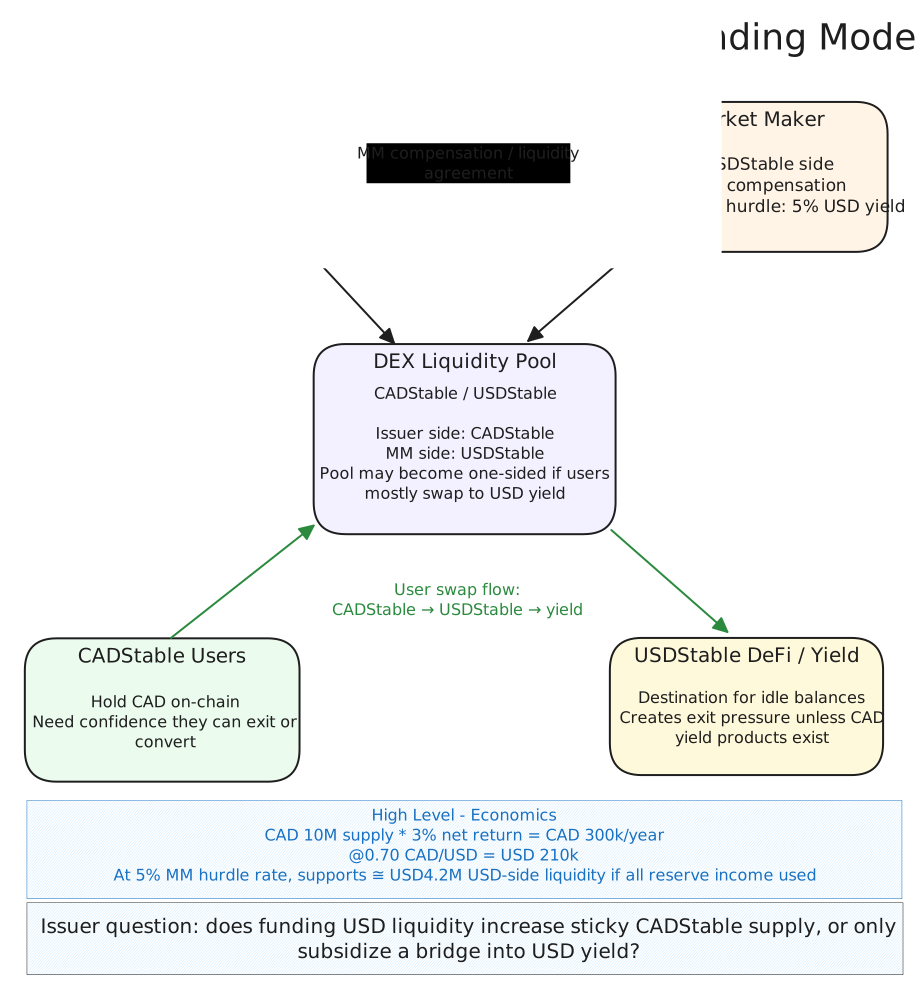
The natural structure is that the CAD stablecoin issuer funds the CAD Stable side of the pool, while a market maker funds the USD Stable side. The issuer then compensates the market maker from its net reserve income.
Callout: simplified liquidity economics
Simplified economic assumptions These numbers are not intended as a precise market-maker quote. They are only a high level way to understand the economic constraint.
Assume:
- CAD stablecoin supply: CAD 10 million
- Net reserve income after operating costs: 3 percent
- Issuer net income: CAD 300,000 per year
- CAD/USD rate: 0.70
- USD equivalent budget: about USD 210,000 per year
- Market maker alternative USD yield: 5 percent
If the issuer used all of its net income to compensate the market maker, it could support about USD 4.2 million of USD-side liquidity at a 5 percent hurdle rate.
In a 50/50 pool, that could support about USD 8.4 million of total pool value, assuming the issuer funds the CAD side.
The key point is not the exact number. Small CAD stablecoin issuers cannot bootstrap deep CAD/USD liquidity from reserve income alone unless the liquidity program increases supply, volume, or both.
Volume is not supply
One mistake would be to confuse DEX volume with stablecoin adoption.
A CAD Stable/USD Stable pool may generate swap volume without increasing average outstanding CAD Stable supply. That distinction matters because the issuer earns reserve income on outstanding supply, not on transaction volume.
If users acquire CAD Stable only to swap into USD Stable and then leave the Canadian dollar on-chain ecosystem, the issuer may be subsidizing volume rather than building sticky supply.
The lopsided pool problem
The key issue is that, in the absence of native Canadian dollar on-chain yield opportunities, these liquidity pools may become unbalanced.
If users mainly use CAD Stable to access USD Stable DeFi, the flow is one-way:
CAD Stable -> USD Stable -> USD DeFi yield
The pool then accumulates CAD Stable and loses USD Stable. The market maker has to replenish the USD side, redeem or offload CAD Stable, hedge FX exposure, or widen spreads.
At that point, the pool becomes a subsidized bridge out of CAD Stable.
For the CAD Stable issuer, this only makes sense if the existence of the pool increases average CAD Stable supply enough to offset the cost of supporting liquidity.
The issuer’s real pitch
The pitch for a CAD stablecoin issuer cannot simply be:
Use CAD Stable for payments and swap into USD Stable to earn USD yield.
That would make CAD Stable little more than a bridge into the U.S. dollar stablecoin market.
The stronger pitch is:
CAD Stable is the Canadian dollar operating balance for on-chain finance, domestic payments, and cross-border settlement.
Users, businesses, payment companies, and institutions are more likely to hold CAD Stable if they know it can be used for Canadian dollar payments, merchant settlement, treasury balances, subscriptions into tokenized Canadian yield products, redemptions, trading, and reliable conversion into USD stablecoins when needed.
Liquidity is therefore not the end product. It is a confidence layer.
The supply growth case is a flywheel:
Liquidity -> confidence -> payment integrations -> usage -> supply -> reserve income -> more liquidity
But the flywheel only works if CAD Stable becomes useful as a base asset.
The Canadian path: payment rail, liquidity rail, yield rail
This is why the likely Canadian market structure is not a yield-bearing stablecoin. It is a layered model.
The first layer is the CAD stablecoin as a payment, settlement, and operating balance rail for Canadian dollar activity.
The second layer is liquidity. Recipients need to know they can convert the CAD stablecoin into other assets when needed.
The third layer is the yield product; a tokenized money market fund, short-term government bond product, RWA vault, or other regulated investment product.
In this structure, a user does not earn yield simply by holding the CAD stablecoin. The user earns yield by subscribing into a separate regulated product. The stablecoin remains the low-risk payment instrument.
This may be the cleaner Canadian model:
- CADStable as the payment and settlement rail.
- DEX, RFQ, and market-maker liquidity as the conversion rail.
- Tokenized RWAs as the yield rail.
- Protocols as the routing and automation layer.
Could foreign USD stablecoins still be accessed on-chain?
Another issue is that Canada’s federal framework appears broader than just Canadian dollar stablecoins. Finance Canada has stated that the framework applies to domestic and foreign issuers that make fiat backed stablecoins available to Canadians, directly or indirectly.
That raises a practical question. If a USD stablecoin such as Open USD, USDC, USDT, or PYUSD does not comply with the Canadian federal framework, could it still be listed on Canadian crypto trading platforms?
The answer is not simply a Bank of Canada question. Provincial securities regulators and the CSA still matter for Canadian crypto trading platforms. Even if regulated exchanges cannot list a foreign stablecoin, that does not necessarily prevent Canadians from accessing it on-chain through a DEX.
This creates a perimeter problem. Canadian regulators can control regulated platforms, dealers, custodians, ramps, issuers, and marketing. They have a much harder time controlling direct interaction with permissionless smart contracts.
How Canadian regulators interpret and enforce this perimeter will have a material impact on how CAD stablecoin issuers can design and support liquidity arrangements.
Conclusion
Open USD highlights an important truth about stablecoins: supply does not grow only because the token exists. Supply grows when there are incentives, integrations, liquidity, and reasons for users to hold balances.
Canada’s framework appears to make a different policy choice than the Open USD model. By restricting yield at the stablecoin layer, Canada is pushing CAD stablecoins toward safer, lower-risk payment instruments. That may be good policy from a risk perspective, but it creates a commercial challenge. Without yield pass-throughs, Canadian stablecoins need another adoption engine.
At first, that engine may be payment partnerships and market-maker-supported liquidity. But over time, the more durable engine is likely to be tokenized Canadian dollar investment products. CAD stablecoins need to become the settlement rail for Canadian on-chain finance, not merely a bridge into USD stablecoin yield.
That may be the Canadian answer to Open USD. Not a yield sharing stablecoin consortium, but a more separated structure: stablecoins as payment rails, tokenized RWAs as the yield layer, and liquidity infrastructure connecting the two.
References and source notes
Market related data highlighted in this article is based on July 1, 2026 data-
Open Standard, “Introducing Open USD”
https://joinopenstandard.com/blog/introducing-open-usd -
Reuters, “Consortium including Visa, Mastercard jointly launch new global stablecoin”
https://www.reuters.com/business/consortium-including-visa-mastercard-jointly-launch-new-global-stablecoin-2026-06-30/ -
Circle, USDC transparency and USDC in circulation
https://www.circle.com/usdc/transparency -
Coinbase, “Coinbase and Circle announce the launch of USDC”, October 2018
https://www.coinbase.com/blog/coinbase-and-circle-announce-the-launch-of-usdc-a-digital-dollar -
Paxos/PyUSD attestations https://www.paxos.com/pyusd-transparency#pyusd-attestations
-
Finance Canada, “Canada’s Stablecoin Framework”
https://www.canada.ca/en/department-finance/programs/financial-sector-policy/canadas-stablecoin-framework.html -
Bank of Canada, Stablecoins regulatory oversight page
https://www.bankofcanada.ca/regulatory-oversight/stablecoins/ -
Latham & Watkins, “The GENIUS Act of 2025 Stablecoin Legislation Adopted in the US”
https://www.lw.com/en/insights/the-genius-act-of-2025-stablecoin-legislation-adopted-in-the-us -
Senate Banking Committee, CLARITY Act section-by-section summary
https://www.banking.senate.gov/imo/media/doc/section-by-section.pdf -
Galaxy, CLARITY Act Senate Banking markup analysis
https://www.galaxy.com/insights/research/clarity-act-senate-banking-markup-may-2026-analysis
Have a project in mind?
If you're exploring blockchain infrastructure, DeFi protocol design, or emerging tech strategy, let's discuss how I can help.